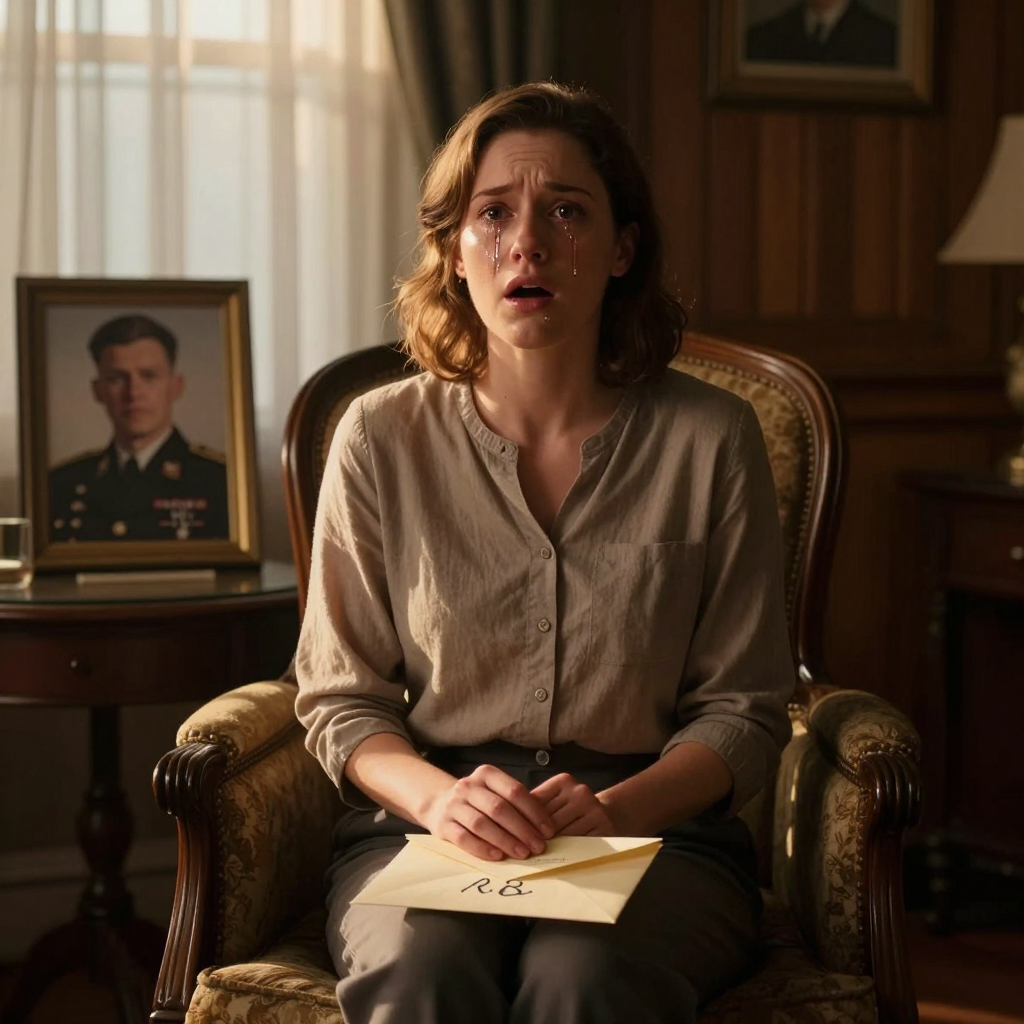
They say the hardest part of grief isn’t the loss itself, but the slow erosion of your reality. The way a steady, comforting lie can calcify into the bedrock of your existence until a single, misplaced piece of evidence cracks the foundation wide open. For fifteen years, that rock was my father’s death—a sudden, catastrophic event in some distant, unforgiving military zone during a deployment I barely understood as a child. My mother, Clara, had wrapped that truth in layers of loving sorrow and practical necessity, telling me every birthday, every quiet evening on the porch swing, that Robert had been lost to an aerial mishap, vaporized by shrapnel before my first crib months had passed.
I grew up steeped in this narrative. Dad was a hero who paid the ultimate price; he was the reason our small coastal town felt slightly more vibrant, slightly warmer. He was the ghost in the attic of happy memories. My childhood recollections were curated vignettes: blurry photographs from deployment bases bathed in harsh sunlight, the crisp scent of olive drab uniforms, and my mother’s perpetually damp eyes when she recounted the cockpit explosion that stole him.
Clara didn’t just *say* he died; she lived his death. She grieved with a fierce, unwavering commitment that was both beautiful and suffocating. There were no ‘what ifs,’ only ‘he is gone.’ The absence had filled in all the blanks—the unanswered questions about why we never saw him, the silence on holidays when other families shared stories of their fathers’ banter. He simply *was* absent. And I, Amelia, accepted it with the earnest faith of a child who trusts her caregiver absolutely.
My own adolescence was spent trying to reconcile the idealized, steadfast image of ‘Dad’ with the vague ache of his non-existence. Was he brave? Was he heartbroken over leaving us behind? Or was he just… gone?
Then came the mail. It wasn’t a glossy postcard from deployment or a stiff official obituary notice. It arrived on a Tuesday, slipped through the slot by a postal worker who seemed unusually hesitant, as if handing over something fragile and explosive. The envelope itself was heavy stock, cream-colored, sealed with a thick, institutional red wax stamp that bore the insignia of the Federal Correctional Complex, ‘Ironwood.’ The return address was stark: *Administrative Records Unit, Ironwood Penitentiary, Somewhere in Northern Georgia.* My mother hadn’t mentioned receiving any official correspondence lately. She usually kept to local town newsletters and utility bills.
My hands trembled so violently I almost tore the seal. Inside, nestled against a pale blue cardstock backing, was a letter. The stationery was severe, utilitarian—a stark white, slightly rough texture that screamed ‘government-issued’—and it bore the pre-printed header: *Inmate Correspondence Log #48290.* My heart began a frantic, irregular drumming against my ribs, mimicking the sound of an engine sputtering to life.
The handwriting.
It was unmistakable. It wasn’t the looping, slightly rushed cursive Clara sometimes recalled from faded letters; this was more deliberate, stronger, imbued with a weariness that age and hardship impart. The slant was perfectly matched, the pressure points on the downstrokes exactly as she described them in her most wistful reminiscing. It was Robert’s hand.
My breath hitched. I stared at the loops of his capital ‘R,’ recognizing the slight flourish Clara always said he did when signing off after a particularly good night’s poker game with Sergeant Miller. This wasn’t the script of a man reduced to memory; this was the handwriting of a living, breathing entity confined behind reinforced steel.
I unfolded it slowly, resisting the urge to scream, instead forcing myself to read the opening line—the one that seemed designed specifically to dismantle years of carefully constructed denial:
\*”Amelia, my brightest star. If you are reading this, then the news has finally traveled through bureaucracy faster than a hummingbird’s wings. Your mother, bless her stubborn heart, was… correct about some things, but tragically mistaken about others.”*
The world tilted. The sunlight streaming into our modest living room seemed to fracture into a million dazzling, accusatory beams. My father wasn’t dead; he was *misplaced*.
I flipped the page, desperate to absorb the seismic shift in my personal history. Robert explained that his deployment hadn’t been a single mission but an extended tour where complications arose—a skirmish went sideways, not smoothly into extraction as the official reports suggested. The initial flight report listed him as MIA due to equipment failure; they never found the wreckage because the hostile elements had retrieved it.
“They filed me under ‘KIA – Unknown Casualty’ for nearly fifteen years,” he wrote, his script growing heavier, more urgent on this page. “But I wasn’t dead, sweetheart. Just very, very stuck.”
The narrative deepened from military tragedy to something far richer: endurance. He hadn’t succumbed to the sudden blast; he had survived it, battered and bruised, only to be caught in a subsequent sweep operation where he was captured, classified as critical but alive, and then processed into the penal system—a necessary measure when you’ve violated the sanctity of international deployment protocol.
The letter detailed his journey through Ironwood. The initial shock of confinement, the brutality of the routine, the aching longing for a familiar scent—Clara’s lavender soap, perhaps. He wrote about the slow erosion of hope, how the constant noise of heavy boots and clanging metal threatened to bury the memory of sunshine.
“I have been holding onto your image,” he admitted, and that simple statement felt like a physical weight being placed gently on my chest. “The moment I saw photographs of you—your gap-toothed grin at age seven—it was like a lighthouse beam cutting through thick fog. You were the anchor to everything sane.”
But the letter wasn’t just an explanation; it was an invitation, and it demanded immediate action. He outlined a procedure: since my mother’s documentation held his original military ID number (which he had managed to retain), she could officially petition for his transfer or at least for verified contact.
The final paragraphs were a symphony of emotion—a masterful blend of paternal pride, enduring love, and weary resignation regarding the bureaucratic hellscape that kept him caged. He apologized not for dying, but for *waiting*. For making us mourn a finished story when the plot was still violently unfolding.
“Amelia,” he concluded, signing off with two elegant, powerful capital letters—R. B.—“Tell your mother this: The accident report is technically true, yes. But it omits the most important detail. You didn’t lose him to a single moment of fire; you lost him to a long stretch of gray monotony. And now,” his pen seemed to lift slightly, pausing for dramatic effect, “now that I have found my way back onto paper, I need you to help me find my way home…”