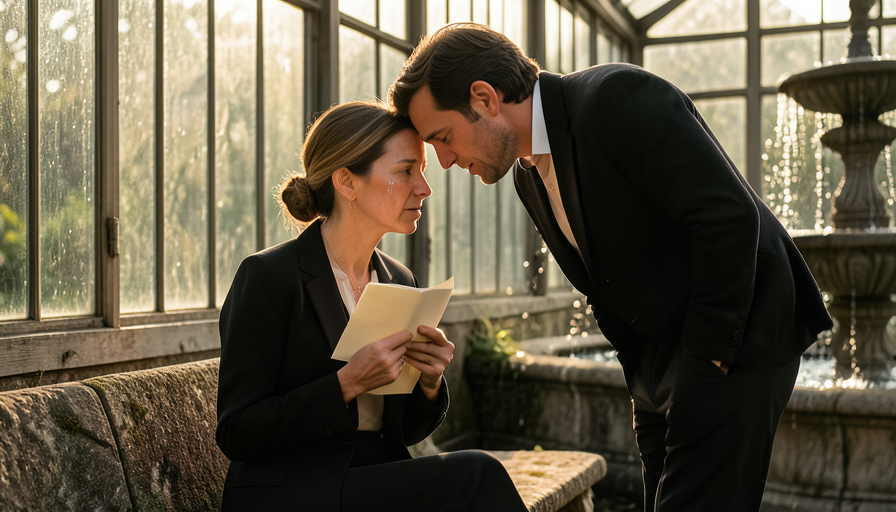
The scent of polished mahogany, old leather bindings, and the faint, lingering aroma of expensive pipe tobacco—that was the olfactory signature of the Atherton family. It smelled like permanence, like tradition, like the perfectly curated life my husband, Elias, and I had painstakingly built together over a decade and a half. We were standing in the cavernous library, beneath the soaring vaulted ceiling where dust motes danced in shafts of late-afternoon sunlight, watching Mrs. Atherton—Elias’s mother—read his final testament. It was supposed to be a moment of dignified closure; a quiet confirmation that our beautiful, complicated life together was validated by the weight of the legal parchment.
Elias, ever the composed patriarch even when facing mortality, gripped my hand so tightly it bordered on painful. My own fingers were trembling slightly, not from grief, but from a strange, anticipatory dread. Fifteen years. We had weathered corporate meltdowns, navigated two disastrous renovations, celebrated quiet anniversaries with lukewarm Chardonnay, and built a sanctuary of predictable joy in our suburban haven. We thought we knew the contours of each other’s souls; we were experts in shared history.
The lawyer, Mr. Hemmings, read through the clauses concerning the estate—the antique clock, the vineyard plot in Tuscany, the notoriously grumpy garden gnome collection—until he reached the final codicil section. He paused, a knowing glimmer in his usually stoic eyes, and nodded toward Mrs. Atherton.
She hadn’t been reading from the main sheaf of documents; she held a slimmer, cream-colored folder tucked discreetly beneath her arm. Her gaze flickered to me, bypassing Elias momentarily, as if recognizing a hidden vulnerability in my posture. The library seemed to dim around us, the sunlight softening into a sepia haze.
Then, with an economy of movement that spoke volumes about decades of practiced grace, she reached out and pressed a single, ivory-colored envelope into my palm. It was sealed with deep crimson wax bearing the Atherton crest—the rampant stag. Before my stunned mind could even process the tactile sensation, her lips moved, barely disturbing the air between us.
*“Don’t open this until you’re alone, darling,”* she breathed. The words were a silken thread woven through the heavy silence of the library. *“It changes everything.”*
Everything. That word hung in the air like smoke before it dissipates—heavy, inescapable, charged with potential devastation. Elias turned to her, confusion etching itself around his strong jawline. “Mother? What is this? Is there a stipulation for Clara?”
Mrs. Atherton simply smiled, that enigmatic, knowing curve of her mouth, and gently squeezed my shoulder before returning her attention to the lawyer. “It concerns *her* legacy, Robert. Hand it over when she’s ready.”
I felt Elias’s gaze pivot to me again. It wasn’t questioning; it was demanding. He expected an immediate reaction—a gasp, a frantic look toward his mother for context, a quick question about inheritance tax implications. But the whisper echoed in my skull, overriding every learned instinct. *Alone.*
The reading continued, but it felt muted now, like watching a play through frosted glass. The discussion moved to liquid assets, trusts established in 1998, and finally settled on the charitable donations—the local historical society receiving a surprisingly large chunk for ‘cultural preservation.’ My focus was trapped inside my own chest, where the envelope rested against the fine wool of my blouse, radiating an almost palpable heat.